Lesson 3 of 1511 min read
Bin cleaning equipment: what you need and where to buy it
Every part of a bin cleaning rig explained: pressure washers, hot water, tanks, lifts, spinner heads, chemicals and safety gear, with US builders and prices.
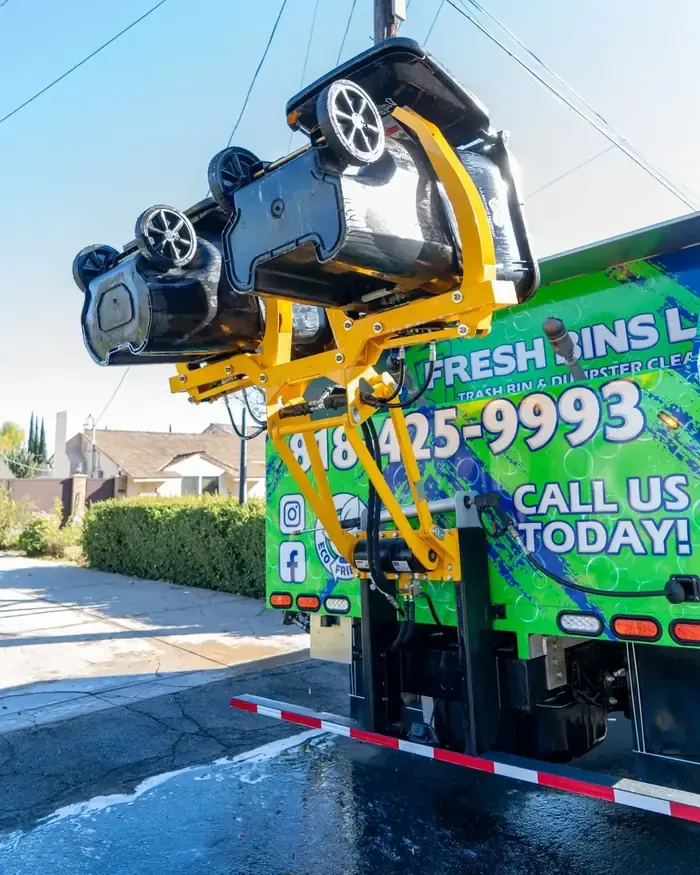
A bin cleaning rig is a pressure washer, a water tank, a wastewater tank, a way to tip the cart, and a spinning head that washes the inside. Hot water and a lift are the two upgrades that cost the most and save the most time.
This lesson explains each part in plain words, what it costs on its own, and what to look for. Prices are as listed by US dealers and builders in October 2026. Lesson 2 has the complete setups.
The parts of a rig
Inside a bin cleaning trailer
- Fresh water tank. Clean water for the day: 225 to 525 gallons on turnkey trailers. Builders’ own bins-per-tank figures work out to about 2 to 4 gallons a bin.
- Wastewater tank. Holds the dirty water you capture, usually 200 to 425 gallons, kept apart from the wash chamber so it can’t slosh out on the road.
- Pressure washer. A gas engine driving a belt-drive pump. Entry rigs run 4 to 5.5 gallons a minute at 3,000 to 4,000 PSI; pro rigs about 8 gallons a minute at 3,500 PSI.
- Hot-water burner. A diesel-fired coil that heats the water to about 200°F on its way to the head. Adds roughly $4,000 to $16,000 to a rig.
- Hose reel and wand. For the outside of the cart, the lid, the handle and the wheels, and anything the spinner misses.
- Lift or tipper. Turns the cart upside down over the wash chamber. Manual and gas-strut lifts are cheap and simple; hydraulic and grabber lifts save your back.
- Spinner head. A 360° rotating head that washes the inside of the cart in under a minute. Its pressure and heat ratings must match your pump and burner.
Setups vary: some carry the washer and burner on a skid in a truck bed, and some tip carts by hand instead of with a lift.
The pressure washer: flow matters more than pressure
Two numbers describe a pressure washer. PSI is how hard the water hits. GPM, gallons a minute, is how much water moves, and that’s what flushes a cart clean. Bin builders favor flow.
- Entry trailers run 4 to 5.5 GPM at 3,000 to 4,000 PSI.
- A common pro setup is about 8 GPM at 3,500 PSI (Viking Upfit).
- One builder says 8 GPM cleans 30% faster than 5.5 GPM. That’s the seller’s own claim.
Match the engine to the pump. A 13-horsepower (390 cc) engine like the Honda GX390 drives about 3.5 to 4 GPM at 4,000 PSI, and makers disagree on which (Hydro Tek), so treat nameplate ratings as best case. An 8 GPM washer needs a 22-horsepower engine like the GX690.
Gas, not electric, on a mobile rig. A standard household outlet tops out around 1,100 PSI at 2 GPM. Electric and battery washers matter more in California, where new gas engines face new rules (see the end of this lesson).
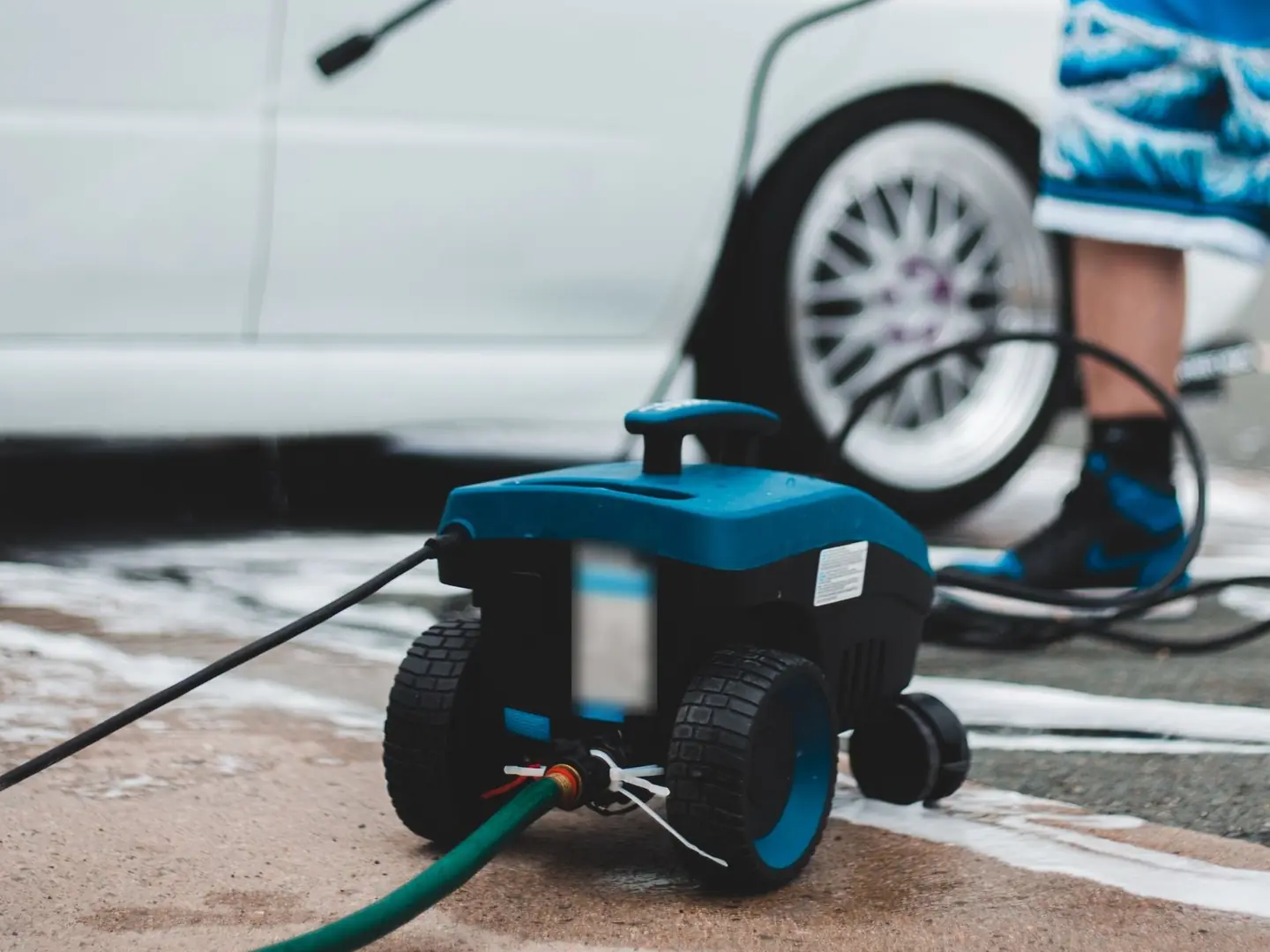
Belt drive. In a direct-drive washer the pump bolts to the engine shaft. A belt drive turns the pump slower through pulleys. Every bin system we found that names its drive uses a belt or a truck’s power takeoff.
| Washer | What it is | Listed price |
|---|---|---|
| PSI B4040HC | 4,000 PSI, 4 GPM, cold, Honda GX390, belt drive | $2,399 |
| Pressure Pro EB4040HG20 | 4,000 PSI, 4 GPM, cold, Honda GX390, belt drive | $2,499 |
| Pressure Pro 8 GPM | 3,500 PSI, 8 GPM, cold, Honda GX690; hose and gun kit $525 extra | $4,899 |
| Hot 4 GPM washers | 4,000 PSI, 4 GPM, with a diesel burner | $6,335 to $8,849 |
| Hot 8 GPM washers | 3,500 PSI, 8 GPM, with a diesel burner | $12,136 to $16,272 |
Prices from 3R Pressure Washers.
Hot water: what it does and what it doesn’t
A hot-water burner is a diesel-fired coil that heats the water on its way to the gun, to about 200°F. Many bin rigs use 12-volt burners that run off the battery, so they need no generator.
What heat does well: grease. A washer maker reports hot water cleaned grease four times faster than cold in its tests (Nilfisk, the maker’s own claim). Builders agree that heat loosens what pressure alone won’t.
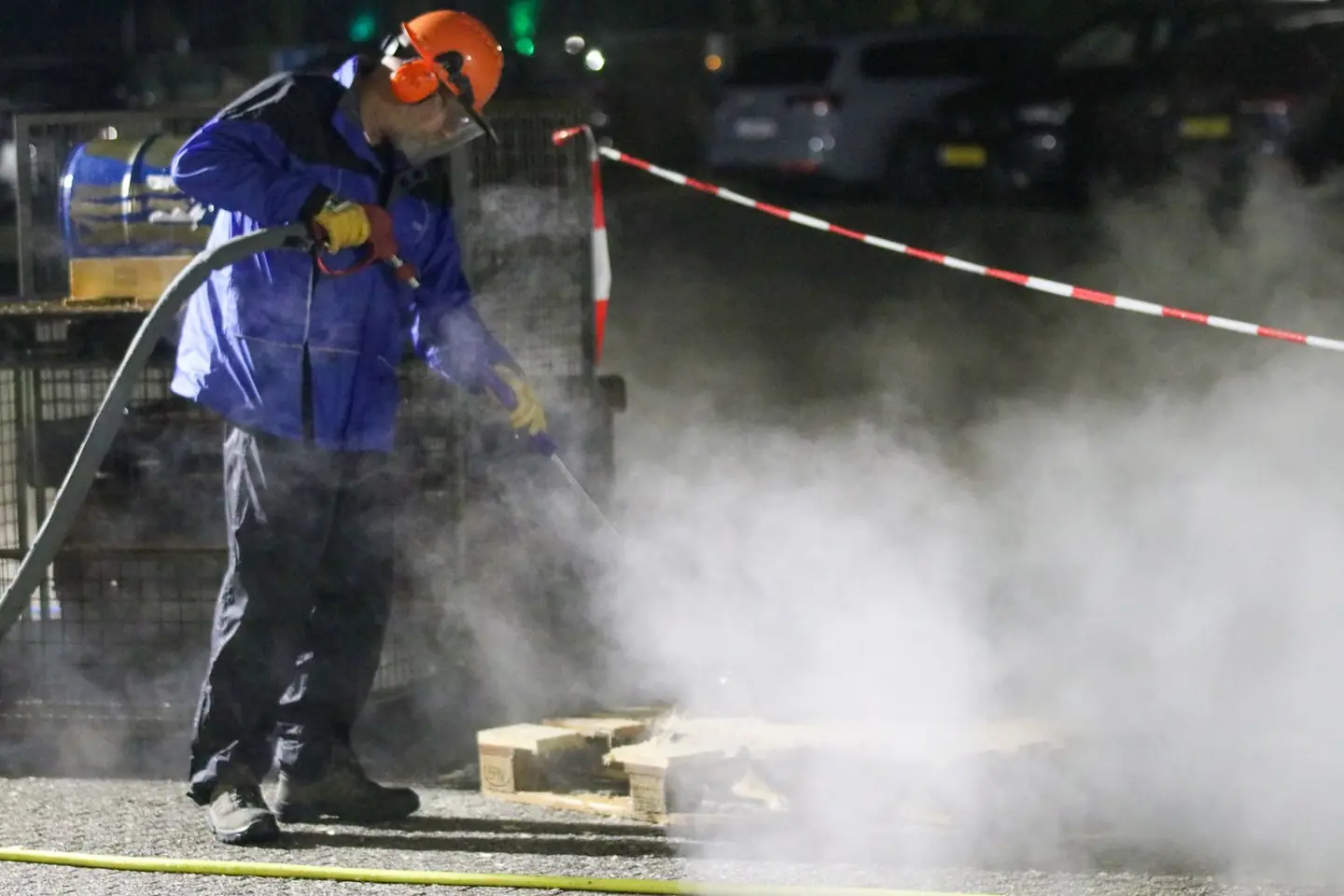
What heat doesn’t prove: that a cart is disinfected. The same maker cites a study where cold water had no effect on bacteria, 140°F water cut them 90% and 176°F water cut them 97%, and it still says hot water alone isn’t enough to sanitize. One trailer builder says heated water alone “is not a verified disinfection claim” (The Bin Trailer). So sell hot water as a better clean, not as germ-killing.
What hot water costs.
- As an upgrade, about $4,000 to $16,000. Kraken charges $5,999 for it; The Bin Trailer’s hot model costs $16,000 more than its cold one, with a bigger axle.
- A separate hot box for an existing washer runs $2,599 (5 GPM) to $4,299.99 (8 to 10 GPM) (Cigar City Softwash).
- Fuel: a 315,000 BTU burner burns about 2.3 gallons of diesel an hour at full fire. It only fires while you spray, so 100 bins at about a minute each uses roughly 4 gallons at most. Our arithmetic, from EIA figures.
How big a burner? Heating water takes about 500 BTU an hour for each gallon a minute and each degree of rise. So 8 GPM heated 140°F needs about 560,000 BTU an hour, and 5.5 GPM heated 100°F needs about 275,000. Cold winter water needs more.
Watch out: Check every part’s temperature rating. Burners advertise 200°F or more, but one popular spinner head is rated to 194°F (Bolondi). Coils also scale up over time, so ask when a used burner was last descaled.
Tanks: plan for the route, and for the weight
Turnkey trailers carry 225 to 525 gallons of clean water; trucks carry 525 to 925. How many bins a tank covers depends on how long you spray:
| Rig | Clean water | Builder’s bins per tank | Gallons a bin |
|---|---|---|---|
| Sparkling Bins SB1 or SB2 | 325 gal | 75 to 100 | 3.3 to 4.3 |
| Garbage Can Cleaning single trailer | 380 gal | 120 to 160 cans | 2.4 to 3.2 |
| Sparkling Bins SB2, large tank | 525 gal | about 200 | 2.6 |
| Sparkling Bins SB4 truck | 625 gal | up to 300 | 2.1 |
Bins per tank are the builders’ claims; gallons a bin is our arithmetic. First cleans of filthy carts use far more.
A tank’s size isn’t the water you can carry. The Bin Trailer limits its 275-gallon tank to 200 gallons on the road for weight and safety (The Bin Trailer). Water weighs 8.33 pounds a gallon:
Size the tank to your busiest day plus about 20%. A refill in the middle of a route can cost you 45 minutes. Bare tanks are cheap: about $725 for 100 gallons and $899 for 200.
The wastewater tank
Most turnkey trailers have a separate wastewater tank of 200 to 425 gallons. A separate, closed tank is better than using the wash hopper itself as the tank, because an open hopper can slosh out on the road. Screens and filters protect your pump; they don’t change where the water may go (Lesson 5).
For dumpster pads and driveways, you need a way to pick water up off the ground. Portable wash-water recovery units cost about $2,860 to $3,120, and larger filter-and-vacuum systems $7,119 to $8,319 (SCE).
Lifts and tippers
The lift tips the cart upside down over the wash chamber. It’s the difference between a sore back and a long career.
| Type | How it works | Example and price |
|---|---|---|
| None | You position the cart; the heads do the work | Kraken’s design has no hydraulic arms |
| Manual or gas strut | You tip the cart with help from springs or struts | Garbage Can Cleaning assisted lifter, $5,000 |
| Lever tipper, stand-alone | Tips the cart on its side for hand washing | Solus Bin Blaster, $5,700 |
| Push-button hydraulic | A battery-powered arm | Garbage Can Cleaning charges $8,000 more for it on a trailer |
| Grabber | Arms like a garbage truck’s tipper; dual versions take two carts | Viking Upfit lifter with hopper, $9,000 |
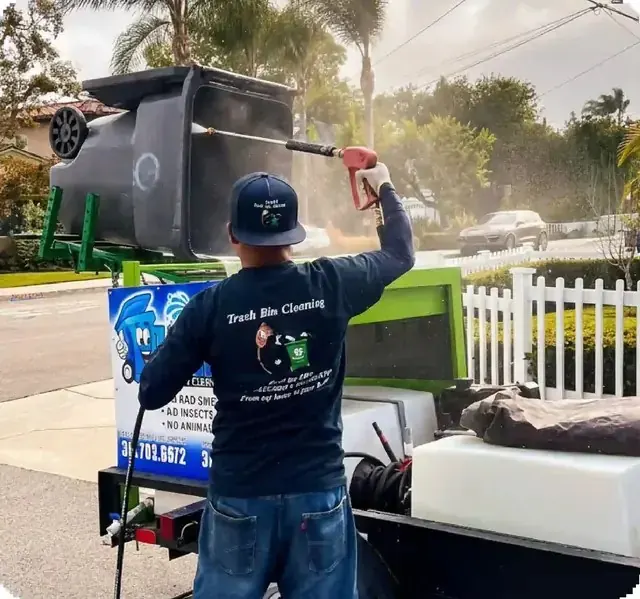
A setup built for 96-gallon carts doesn’t automatically handle dumpsters. Dumpster lifts are a separate, bigger investment.
The spinner head
A 360° head spins inside the upturned cart and sprays every surface. One popular model runs a 14-second cycle at 100 RPM (Bolondi), which uses about a gallon at 4 GPM.
- Price: $1,999 for a generic stainless head (GCC) to $3,491 for a four-nozzle Bolondi on sale (MegaDepot). Another Bolondi model lists at $8,816.83 (SCE).
- Match it to the pump. Heads are rated from about 2,175 to 4,000 PSI. Your pump may run 3,500 to 4,000.
- They wear out. Warranties run 6 to 12 months. Budget for a spare.
Hoses, reels, guns and injectors
- Hose reels: $147 to $500 for manual reels, $810 to $1,240 for electric ones. Many rigs use a short spring reel for cart exteriors and a 100-foot hose for everything else.
- Gun with a 36-inch lance: about $60.
- Extension wands: from $15.
- Chemical injectors: $17 to $80, or $175 for a full injection kit.
Prices from Cigar City Softwash and SCE.
For dumpster pads: surface cleaners and generators
A surface cleaner is a spinning disc that cleans flat concrete without streaks. They run from $135 for a 15-inch to $2,400 for a large 28-inch model; match it to your washer’s GPM and PSI. You only need a generator for 115-volt burners, pumps or filters: inverter generators cost $1,582 to $4,961 (SCE).
Chemicals, and what you’re allowed to claim
Most residential operators clean with hot water and a deodorizer, and use little else.
- Degreaser for greasy carts and pads. Gold Assassin is $24.99 a gallon or $119.99 for five. Strong caustics can corrode aluminum hoppers, so check before you buy.
- Deodorizer on every cart. A spray-on, no-rinse product like SCE’s Deodorize It runs $28.99 a gallon up to $692.99 for a 55-gallon drum.
- A registered disinfectant, only if you want to say “disinfect.” Vital Oxide (EPA Reg. No. 82972-1) is one, from $19.95. Its label says surfaces must stay wet 10 minutes to kill bacteria, which doesn’t fit a 60-second curbside wash (SCE).
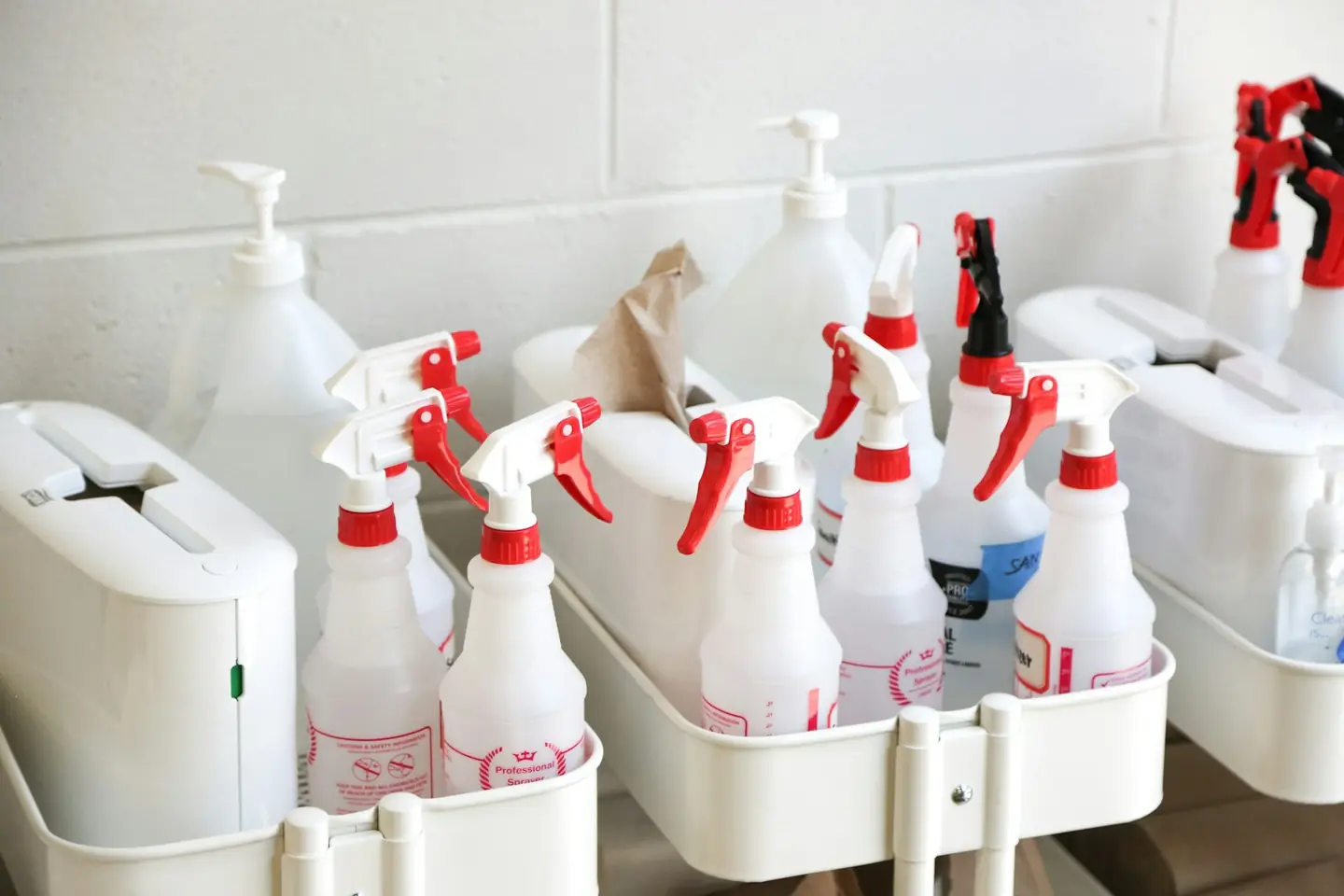
Cost per bin: a seller-run guide puts supplies under 50 cents a bin bought in volume (Clean Bin Opportunity). In our income model, water, heat, engine fuel and chemicals come to about a dollar for a two-bin stop.
The words matter. Under EPA rules, claiming a product kills germs makes it a pesticide that must be registered (EPA). EPA’s guidance covers ads and websites, not just labels.
| Fine to say | Only with a registered product used exactly as labeled |
|---|---|
| Cleans | Sanitizes |
| Deodorizes, removes odors | Disinfects |
| Removes dirt, grime and residue | Kills bacteria or germs, “99.9%” |
| Uses hot water | Controls odor-causing bacteria |
Avoid “EPA approved,” “hospital grade” and “non-toxic” altogether. Lessons 5 and 11 cover the advertising rules.
Safety gear
| Item | Price |
|---|---|
| Nitrile gloves, 100 | $12.99 |
| Long-cuff chemical gloves | $8.99 |
| Safety glasses or goggles | $2.49 to $6.99 |
| Two-piece rain suit | $14.99 |
| Earplugs, 50 | $4.99 |
| Starter kit | about $44 |
Harbor Freight prices (Harbor Freight). Add rubber boots, a high-visibility shirt, long tongs and a sharps container (Lesson 8). Once your rig counts as a commercial vehicle, federal rules also require a fire extinguisher and three warning triangles (49 CFR 393.95), and with a diesel burner on board you want the extinguisher anyway.
Where to buy: US builders
| Builder | Where | What they sell | Prices |
|---|---|---|---|
| The Bin Trailer | Kissimmee, FL | Cold and hot single-bin trailers, a kit | $14,999 to $45,999; California editions $34,999 and $54,999 |
| Kraken Industries | Oklahoma City, OK | Trailers, truck pods, flatbed kits, a wash-bay unit | $9,999 to $44,999 |
| Garbage Can Cleaning | Spanish Fork, UT | Trailers, truck skids, a kit, lifters | $5,000 to $70,000 |
| Sparkling Bins | Miami, FL | Trailers, pickup skids, PTO trucks, a dumpster truck | On request |
| Viking Upfit | San Antonio, TX | Trailers, skids, trucks with the chassis | $44,995 to $154,995 |
| Trash Bin Cleaners Direct | Allegan, MI | Trailers and truck packages | Call for price |
| Rhino Services | Watertown, SD | Custom trailers | Double-lifter trailer $69,995 |
| What A Bin | San Diego, CA | Used trucks and custom builds | $95,000 to $129,000 used |
Kits and parts: Hot and Mighty, Atomic Bin Systems, Solus, and pressure-washing dealers like 3R Pressure Washers, Cigar City Softwash and SCE.
Questions to ask any builder:
- What exactly is the price, and what’s extra: freight, title, paperwork, the wrap?
- What’s the loaded weight, the axle rating and the minimum tow rating?
- How much clean water can I legally carry on the road?
- Is the wastewater tank separate from the wash chamber?
- What engine, pump, burner and head, and what are their pressure and temperature ratings?
- What’s the warranty on each part, and who services it near me?
- What’s the real delivery date, in writing?
- What training comes with it?
Buying used
Used rigs turn up on equipment-finance company inventories, inspected marketplaces, builders’ used pages, pressure-washing forums, Facebook Marketplace and business-for-sale sites. One 2023 dual-bin trailer with 55 hours was listed at $47,500, about 32% under what a city paid for the same model new.
Inspect before you pay:
- Engine: hours, and a cold start. One inspected trailer’s engine “would crank but would not run.”
- Pump: pressure at the gun under load, and no leaks.
- Burner: does it light and hold temperature? When was it descaled?
- Lift: run it with a full cart. Check batteries and hydraulics.
- Head: it should spin freely. Assume it’s near the end of its life.
- Tanks: cracks and smell; a separate wastewater tank.
- Freeze damage: was it winterized?
- Trailer: the weight-rating label and VIN, tires, electric brakes, lights, jack and hitch size.
- Paperwork: title in hand, no loan on it, and an emissions label (in California, check its CARB status). Ask whether the warranty transfers.
California’s engine rule
California’s small off-road engine rule makes new pressure-washer engines of 225 cc or more (a GX390 or GX690) zero-emission from model year 2028 (13 CCR 2403). You can keep using and repairing what you own. Some builders already sell California editions for $5,000 to $9,000 more. A resolution in Congress to overturn the 2028 rule was in committee as of September 2026, so check its status before you buy.
Key takeaways
- Flow (GPM) cleans carts; pros run about 8 GPM at 3,500 PSI. Match the engine, pump, head and burner ratings.
- Hot water cleans grease faster but isn’t a disinfection claim on its own.
- Water is heavy: 500 gallons weighs over 4,100 pounds. Size the tank to your route and your truck.
- Say “cleans and deodorizes.” Say “disinfects” only with an EPA-registered product used exactly as its label says.
- Get every builder’s price, inclusions, weights and delivery date in writing, and inspect used rigs in person.
FAQ
What equipment do I need to start a bin cleaning business?
A pressure washer, a clean-water tank, a wastewater tank or recovery setup, a spinner head, a way to tip the cart, hoses and a wand, deodorizer, and safety gear. Most people buy these together as a turnkey trailer for $25,000 to $65,000. A truck strong enough to tow it, and insurance, come on top.
Do I need hot water to clean trash bins?
No, but it helps. Hot water cuts grease and sticky residue faster, and many customers expect it. It adds $4,000 to $16,000 to a rig. Plenty of operators start cold and add a hot box later for $2,599 to $4,300. Either way, don’t advertise hot water as killing germs.
How many bins can you clean with one tank of water?
Builders claim 75 to 200 bins from a 325- to 525-gallon tank, or about 2 to 4 gallons a bin. A first clean of a filthy cart uses much more. Time your own first route and size your tank to your busiest day plus about 20%.
What’s the best pressure washer for bin cleaning?
A gas, belt-drive washer around 8 GPM and 3,500 PSI is the common pro choice, on a 22-horsepower engine. Entry rigs run 4 to 5.5 GPM. Match the pump to your spinner head’s pressure rating and your burner’s temperature rating.
Where can I buy used bin cleaning equipment?
Equipment-finance company inventories, inspected marketplaces like Boom & Bucket, builders’ used pages, pressure-washing forums, Facebook Marketplace and business-for-sale listings. Inspect the engine, pump, burner, lift and trailer in person, and make sure there’s no loan on the title.