Lesson 8 of 159 min read
How to clean a trash bin, step by step
The professional bin cleaning process stop by stop, from timing and hot water to maggots, broken carts, missed bins, winter and the safety rules at the curb.
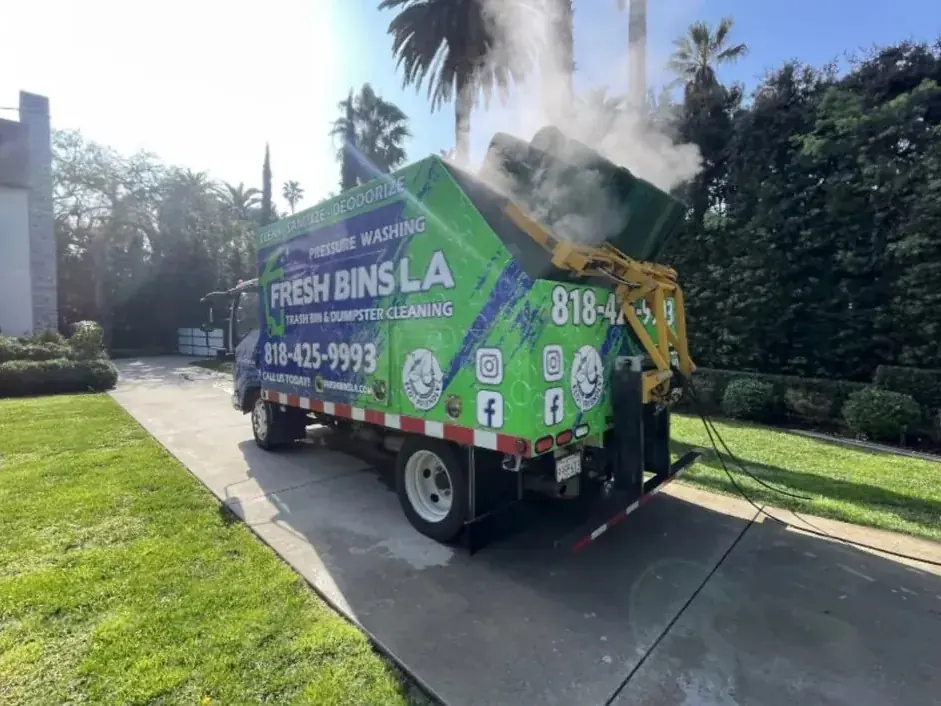
The cleaning itself is the easy part. Operators and equipment makers describe almost the same sequence, and on a purpose-built rig the wash takes about a minute. What separates a good operator is everything around it: arriving at the right time, photographing every cart, handling the cart that isn’t out, and getting home safe.
Same day or next day?
A cart can only be cleaned empty, and it’s only reliably empty right after pickup. So operators clean on trash day after the truck passes, or the next day. Both work:
- Same day: Fresh Bins LA cleans right after the trash truck leaves.
- Next day: many operators, including Waste Bin Wizards, WASH BINS and Can Cleaners, clean the day after.
- Either: some clean the day of and the day after, mostly before noon.
The catch with next day: many cities make residents pull carts in on pickup day.
| City | Carts must be back in by |
|---|---|
| Los Angeles | 8 pm on pickup day |
| Houston | 10 pm on pickup day |
| Coral Springs, FL | 7 pm on pickup day |
| Syracuse, NY | 7 pm on pickup day |
Sources: Clean Bin System trash pickup guides for Los Angeles and Houston, Coral Springs, Syracuse.
Next-day operators get around this by asking customers to leave empty carts in the driveway or beside the house. HOAs may have their own rules; some operators will ask the HOA board for an exception on a customer’s behalf.
One stop, start to finish
One stop, start to finish
- Step 1Arrive after the truckCarts have to be empty. Clean on trash day right after pickup, or the next day where carts may stay out.
- Step 2Check, photograph, liftLook for leftover bags, needles and cracks. Take a before photo, then tip the cart over the wash chamber.
- Step 3Wash the insideThe spinner head runs for 30 to 60 seconds. Scrub off whatever it leaves.About a minute
- Step 4Wash the outsideLid, handle, body and wheels with the wand, over the catch area so the water is captured.
- Step 5DeodorizeDeodorizer on every cart. Disinfectant only if it’s EPA-registered and used exactly as its label says.
- Step 6Return, tag, photoPut the cart back where it lives, tag the lid, take the after photo and mark the stop done.
Two to five minutes a stop on a purpose-built rig, plus the drive to the next one. A filthy first clean takes longer.
In detail:
- Arrive after the truck. Confirm the cart was emptied.
- Look before you touch. Check for leftover bags, loose trash, needles, batteries and existing damage.
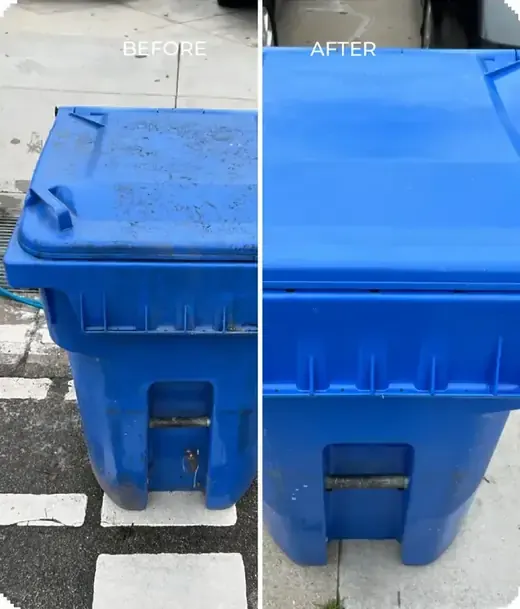
- Take a before photo. Photos settle “you didn’t clean it” and “you cracked it.” The Trash Can Cleaners, with more than 1,000 customers, has drivers photograph damage on arrival.
- Lift and tip the cart upside down over the wash chamber.
- Wash the inside with the spinner head: 30 to 60 seconds on a purpose-built rig.
- Scrub what’s left by hand, and run a second cycle on a filthy cart.
- Wash the outside, lid, handle and wheels with the wand, over the wash chamber or a catch mat so that water is captured too (Lesson 5).
- Deodorize. Nearly every operator does.
- Drain, then wipe it dry.
- Put it back where the customer asked at sign-up. Don’t go behind a gate without written permission.
- Tag the lid, take the after photo, and mark the stop done so the customer gets a “done” text.
How long a stop takes
| Source | Claim |
|---|---|
| Can Cleaners (operator) | 30 seconds to wash a can |
| The Bin Trailer (builder’s claim) | 2 to 5 minutes a stop; 2 to 3 for a repeat clean, 5 to 7 for a filthy first clean |
| DoorstepHQ (blog estimate) | 3 to 6 minutes a bin including the drive-up |
| A real job ad, Miramar, FL | 30 to 35 stops a day, about 7:30 am to 2 pm |
| One operator with a pressure washer and no rig | 15 minutes a bin |
Sources: Can Cleaners, The Bin Trailer, DoorstepHQ, CareerBuilder.
The wash takes about a minute. Positioning, photos, tagging and the drive take the rest. Time your own first 50 stops and use your real number for pricing and routes.
Before and after each route
Opening checklist:
- Fresh tank full, wastewater tank empty.
- Engine oil, coolant and fuel checked. A seller suggests changing washer oil every 50 to 100 engine hours.
- Burner and pump tested.
- Chemicals labeled, with a safety data sheet for each in the truck.
- Gloves, glasses, tongs and a sharps container on board.
- Tablet or phone charged and the route loaded.
- Any holiday shifts checked (Lesson 9).
Closing checklist:
- Dump the wastewater at your approved site, after it cools. One utility bans anything hotter than 140°F from the sewer.
- In freezing weather, drain the tanks, pump and hoses.
- Log engine hours.
- Close every stop in your app.
- Restock chemicals and supplies.
Hot water and germs
Most residential operators clean with hot water and a deodorizer, and no disinfectant. That’s fine; just say what you do. “Cleaned and deodorized with hot water” is a claim you can stand behind. “Disinfects” or “kills 99.9% of germs” needs an EPA-registered product used exactly as its label directs, including how long the surface stays wet (Lesson 3).
Problem bins
Maggots. In warm weather a house fly goes from egg to adult in about 8 days (Orange County Vector Control). A hot wash kills and flushes them; check the lid rim and the hinge, where they hide. Don’t promise they’ll stay gone, because eggs may already be laid. Tell customers to bag food waste, double-bag meat and seafood scraps, and keep the lid shut.
First cleans. A cart that’s never been cleaned can take two or three times as long. Scrape it, run a second cycle, and tell first-time customers that some stains take more than one visit.
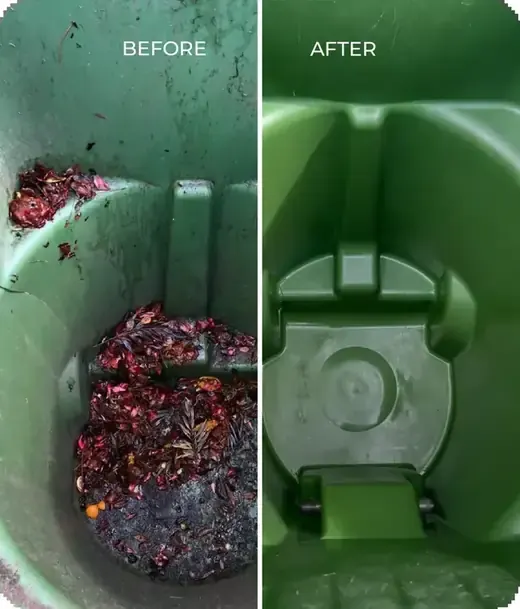
Broken carts. Carts often belong to the city or the hauler, and many cities repair them through a 311 request. Cincinnati, for example, repairs city-issued carts but not privately bought ones (Cincinnati). Photograph damage before you clean, mark the stop “Damaged” with a note, and tell the customer how to request a repair. Don’t fix city property yourself, and say in your terms that old, sun-brittle carts can crack during normal cleaning.
Carts that weren’t emptied. Pick a rule and publish it:
- The Bin Men take out one or two medium bags and put them back; with more, the clean is skipped and rescheduled.
- Fresh Bins LA requires carts to be fully empty.
- Clean Those Cans charges 50% for a cleaning it can’t do.
If the hauler missed the cart, the customer reports it to the city. Los Angeles takes missed-pickup reports after 6 pm on collection day.
Carts that aren’t out, are blocked, or are behind a gate. Log it with a photo and a note and text the customer right away. WASH BINS crews never go behind gates; The Bin Men only do with explicit permission.
Your missed-bin policy
| Company | If the cart isn’t out | Notice to skip |
|---|---|---|
| WASH BINS | Still charged, plus $10 a bin to reschedule ($50 a dumpster) | 24 hours |
| The Bin Men | $10 fee, no credit | 24 hours |
| Clean Those Cans | 50% of the price | |
| Bin Bath | May charge a fee; free with notice | As early as possible |
| Mr. Clean Bins | Cleaned on the next cleaning day |
Sources: WASH BINS, The Bin Men, Clean Those Cans, Bin Bath, Mr. Clean Bins.
A fair approach: publish the rule on your sign-up page, send a reminder the day before every cleaning, photograph every missed stop, and waive the fee the first time. A good reminder helps prevent missed bins in the first place: The Bin Trash Spa credits its day-before text with getting bins left out.
Winter and weather
| Company | Winter rule |
|---|---|
| Clean Those Cans, NE Ohio | Cleans March to November; nothing below 35°F |
| American Can Cleaners, N. Colorado | Homes March to November; December to February by appointment |
| MN Bin Bath, Minnesota | Pauses below freezing; subscribers aren’t charged during the pause |
| The Bin Trash Spa, Reno | Above freezing only; inside of the cart only in winter, so no ice is left on the street |
| Bin Bath, Pittsburgh | Year-round, with slack in the schedule for the worst weeks |
Sources: Clean Those Cans, American Can Cleaners, MN Bin Bath, The Bin Trash Spa, Bin Bath.
Freezing water cracks pumps and hoses. In the cold: don’t clean below freezing, drain the tanks, pump and hoses every night, run antifreeze through the washer, keep the rig in heated storage if you can, and check seals and hoses often. Lesson 12 covers billing and marketing through the slow months.
Safety at the curb
Traffic is the biggest risk. Refuse collectors, who work the same curbs, had the fifth-highest fatality rate of any job in 2024, 37.4 deaths per 100,000 workers (SWANA, summarizing BLS data). The federal traffic-control manual calls for Class 2 or 3 high-visibility clothing for workers exposed to traffic (MUTCD, Section 6C.05). So:
- Wear a high-visibility shirt or vest. Branded, it doubles as advertising.
- Park so you work on the curb side, with hazard or strobe lights on.
- Never stand in the travel lane to run the lift. Roll carts to the rig instead.
Lifting. NIOSH’s limit for an ideal lift is 51 pounds, and it drops with reach, twisting and repetition (NIOSH). Let the lift do the work, roll carts rather than carry them, and never hand-lift a cart with trash or water in it.
Chemicals. Keep a safety data sheet for every chemical, and once you have employees, OSHA requires labels, data sheets and training (OSHA). Never mix bleach with acids or ammonia: acids release chlorine gas and ammonia forms chloramines (CDC). Use products at the label’s dilution, and never “a glug.”
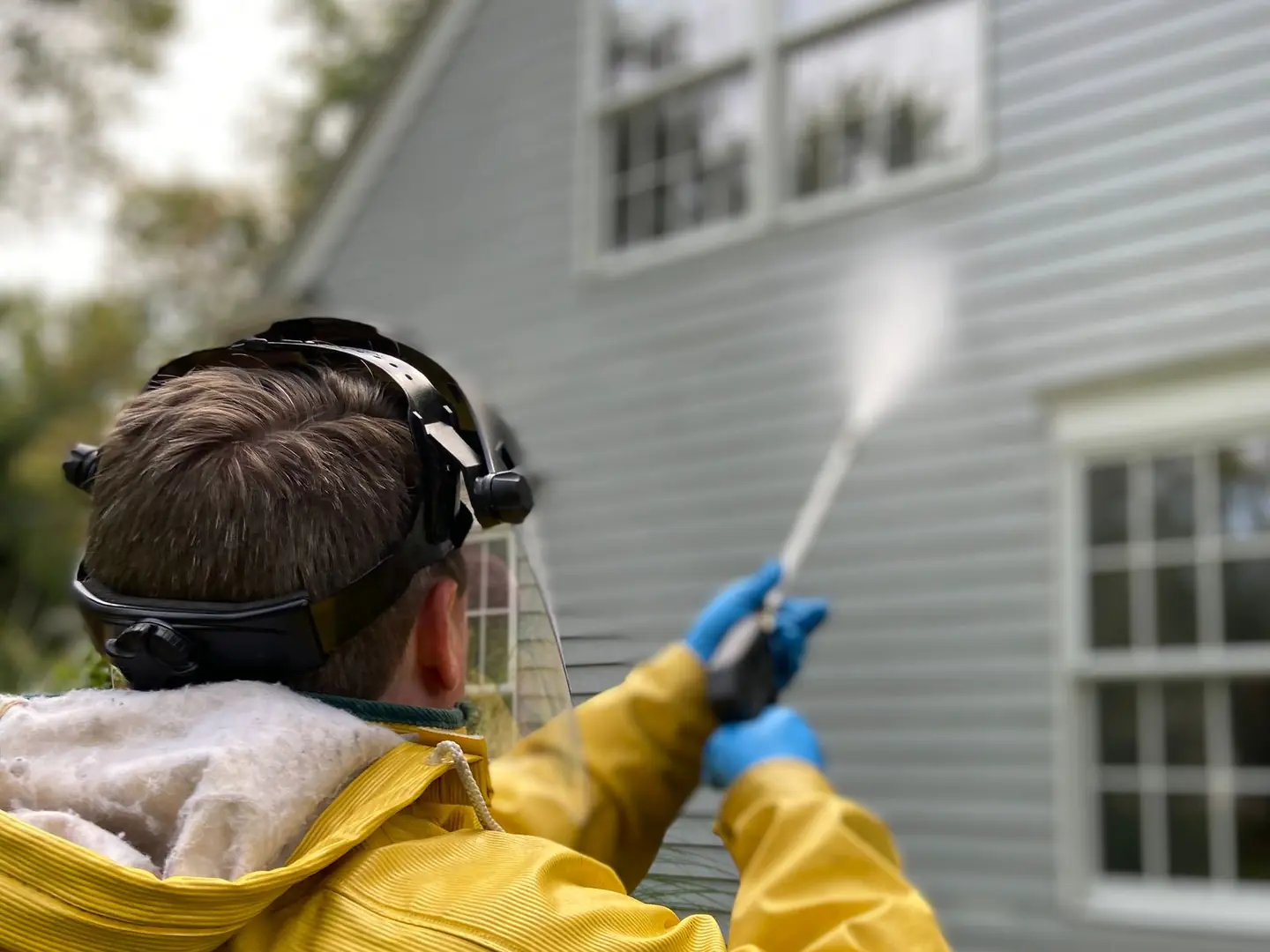
What to wear: cut-resistant gloves under waterproof gloves, safety glasses for spray-back, waterproof non-slip boots, and high-visibility clothing.
Needles. Some needles end up in household trash. Never reach into a cart with your hand; use tongs, and carry a sharps container. If you’re stuck, wash the area with soap and water, report it, and get medical care right away. OSHA points clinicians to the PEPline at 1-888-448-4911 (OSHA).
Lithium batteries. Damaged batteries can start fires (EPA). Don’t blast a battery at the bottom of a cart; lift it out with tongs and bag it.
Heat. Drink water, rest in shade, and do the heavy work in the cooler hours. New workers need a few days to get used to heat. Heat stroke means cooling the person at once and calling 911. The free OSHA-NIOSH Heat Safety Tool app shows the heat index (OSHA). California, Colorado, Maryland, Minnesota, Nevada, Oregon and Washington have their own workplace heat rules.
Ice. Winter overspray freezes on sidewalks and streets. That’s why some operators wash only the inside of carts in winter.
What you won’t clean. Write it into your terms: hazardous waste, building materials, and loose pet waste or unbagged trash are common refusals.
Key takeaways
- Clean after pickup: same day where carts must come in by evening, next day where customers can leave carts out.
- Photograph every cart before and after, and log every missed or damaged one with a note and a text.
- The wash takes about a minute; time your own stops and use the real number.
- Publish a missed-bin rule, remind customers the day before, and waive the first fee.
- Traffic is the biggest hazard. Wear high-visibility clothing, work on the curb side, and never reach into a cart by hand.
FAQ
How do professionals clean trash cans?
They arrive after the garbage truck, photograph the cart, tip it upside down over a wash chamber, and wash the inside with a spinning hot-water head for 30 to 60 seconds. Then they wash the outside over the chamber, deodorize, drain and dry it, put it back, and take an after photo. All the wash water is captured and dumped legally.
How long does it take to clean a trash bin?
On a purpose-built rig the wash takes about a minute, and a stop takes 2 to 5 minutes including positioning, photos and tagging. A filthy first clean can take 5 to 7 minutes. Cleaning by hand with a pressure washer takes much longer, about 15 minutes a bin in one operator’s account.
Do you need hot water to clean trash cans?
Not strictly, but hot water loosens grease and sticky residue much faster, and most professional rigs use it. Hot water alone isn’t a disinfection claim, so advertise it as a better clean, not a germ kill.
How do you get rid of maggots in a trash can?
A hot-water wash kills and flushes them, and you should check the lid rim and hinge, where they hide. Eggs may already be laid, so they can come back. Tell customers to bag food waste, double-bag meat and seafood scraps, keep the lid closed, and stay on a regular cleaning plan in summer.
What happens if a customer’s bin isn’t out?
Many companies we checked charge a fee or count the visit, often $10 a bin, unless the customer gave 24 hours’ notice. A fair approach is to send a reminder the day before, photograph the missed stop, text the customer, and waive the fee the first time.