Lesson 11 of 1510 min read
Google, your website and paid ads
Set up a Google Business Profile, get reviews the right way, build a website that books, and run Google, Facebook and Nextdoor ads that pay for themselves.

In our research on 411 bin cleaners, the companies with the most reviews stand apart in one way: they’re easy to find on Google. 45% of companies with 100 or more reviews were running Google ads, against 4% of companies with under 30. Their websites are bigger, with city pages and blogs. Their prices, their Facebook ads and whether they book online barely differ.
So this lesson is about being found and booked: your Google Business Profile, your reviews, a website that takes payment, and ads that pay for themselves.
Your Google Business Profile
Set it up as a service-area business. You go to customers, so hide your address; Google’s own example is a plumber working from home. Post office boxes and remote mailboxes aren’t allowed, and a virtual office only counts if it’s staffed during business hours (Google).
Service areas. You can list up to 20, by city or ZIP code; you can’t set a radius. Keep them within about two hours’ drive of your base (Google).
Name. Use your real-world name. Taglines, services, towns and phone numbers in the name aren’t allowed (Lesson 10).
Category. Google’s list may not have an exact bin cleaning category. Larger bin cleaners use “Pressure washing service,” and we’ve also seen “House cleaning service” and “Cleaners.” Google’s rule is as few categories as possible, as specific as possible: the one that finishes “This business is a…” Search “trash can cleaning” in your city, open the top three map results, and use the closest category they use.
Services and prices. Add each service (trash can, recycling cart, yard-waste cart, dumpster pad) with its price and what it covers in the service details (Google). Prices belong in Services, not the description: Google says the description shouldn’t focus on prices or promotions, and it can’t contain links. Use the description to say what you clean, where and how, in the words customers use. Add your booking link as the appointment link.
Hours and seasons. Set your real hours. A seasonal business can mark itself temporarily closed in the off-season.
Photos. JPG or PNG, 720 by 720 pixels recommended; videos up to 30 seconds (Google). Shoot your rig, your crew, the lift, wastewater being captured, and real before-and-afters. Keep house numbers and faces out. Add new ones every few weeks.
Other listings. Add the same name, phone and service areas on Yelp, Nextdoor, Bing and Apple Maps, matching your website.
Reviews: what’s allowed and what isn’t
Do:
- Ask every customer right after their first cleaning, with a direct link or QR code (Google).
- Put the link in your “done” text, on your thank-you page and in your website footer.
- Reply to every review, briefly, including the bad ones. Google notes a mix of feedback often looks more trustworthy.
Don’t (Google Maps content policy):
- Offer anything for a review: money, discounts, free cleanings or a prize drawing. We found a bin cleaner offering “a chance to win a free bin cleaning” for a Google review; a drawing is still an incentive.
- Ask only happy customers, or discourage bad reviews. That’s called review gating.
- Set staff review quotas, or ask customers for reviews with specific content, including naming a technician. Google added these bans in April 2026 (PPC Land, a secondary source). “Mention your tech by name!” now breaks the policy.
- Pressure people on site, or post reviews from employees, family or extra accounts.
Google enforces this. It says it blocked or removed 292 million policy-breaking reviews in 2025, and it has been asking some users whether a business offered rewards for reviews (PPC Land, a secondary source).
The FTC’s rule has been in effect since October 21, 2024. It bans fake reviews, including AI-generated ones, buying positive or negative reviews, undisclosed reviews from owners, staff or family, and fake social-media followers (FTC). Knowing violations can cost up to $53,088 each (16 CFR 1.98). The FTC allows a disclosed incentive for an honest review of any kind, but Google bans every incentive, so for Google, follow Google.
Benchmarks: Fresh Bins LA has a 5.0 rating from 82 reviews. The middle company in our list has about 41.
A website that books
Your website has one job: turn a visitor into a paying customer. The checklist, in order of what matters most:
- Prices on the home page, per bin and per plan. 311 of the 358 working bin cleaning sites in our research show them.
- A Book button on every screen that goes straight to checkout, not a contact form. Pin it in the header on phones.
- Plan buttons that open that exact plan.
- “Trash can cleaning” in your page title and main heading.
- A page for each city you serve, titled the way people search: “Trash Can Cleaning in [City].”
- Your phone number as a tap-to-call link.
- Real photos of your rig, crew and before-and-afters. No stock or AI images.
- Real reviews only. Link to your Google reviews rather than typing quotes.
- A plain “how it works”: put your carts out after pickup, we clean them at the curb, you don’t need to be home.
- An FAQ: prices, what’s included, missed pickups, cancellation, HOA curb rules.
- Fast on a phone.
- Tracking that follows an ad click all the way to the payment.
From the BinClean Marketing website checklist.
A sign-up that takes the card
Example from Clean Bin System: plan, bins and trash day, then the card for the first cleaning.
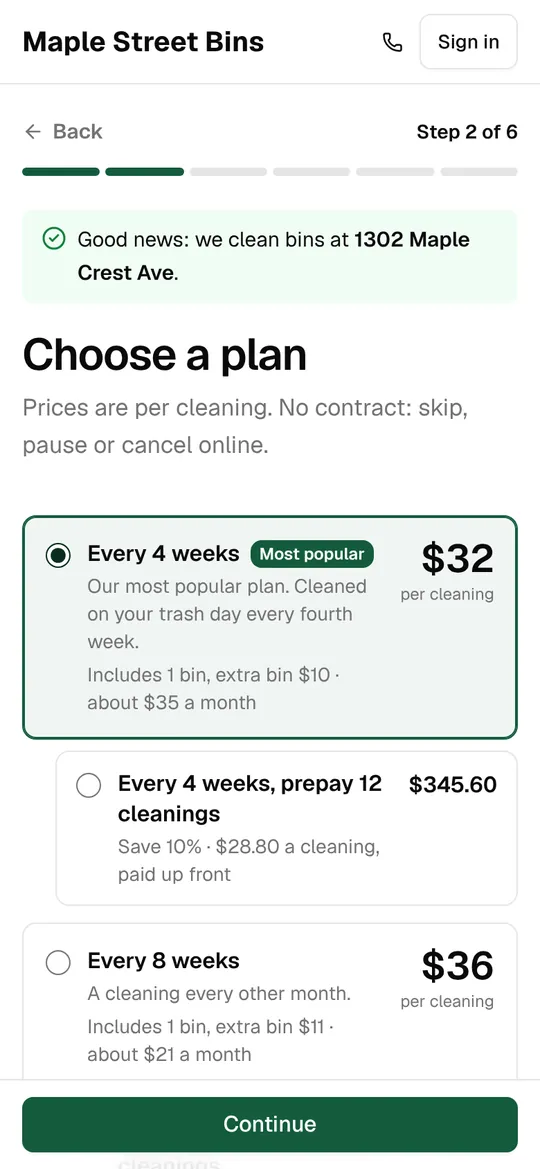
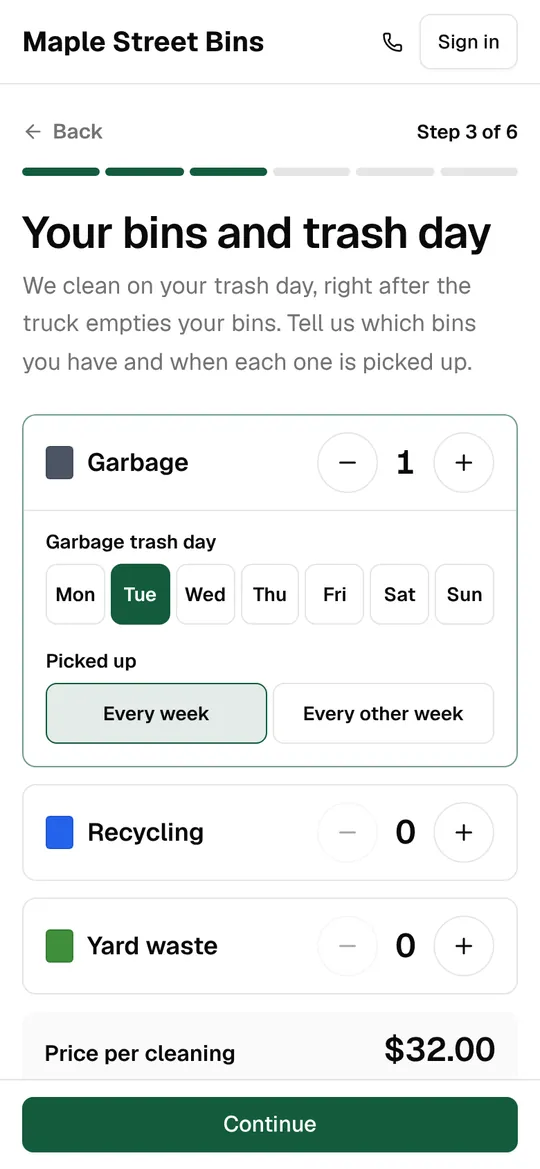
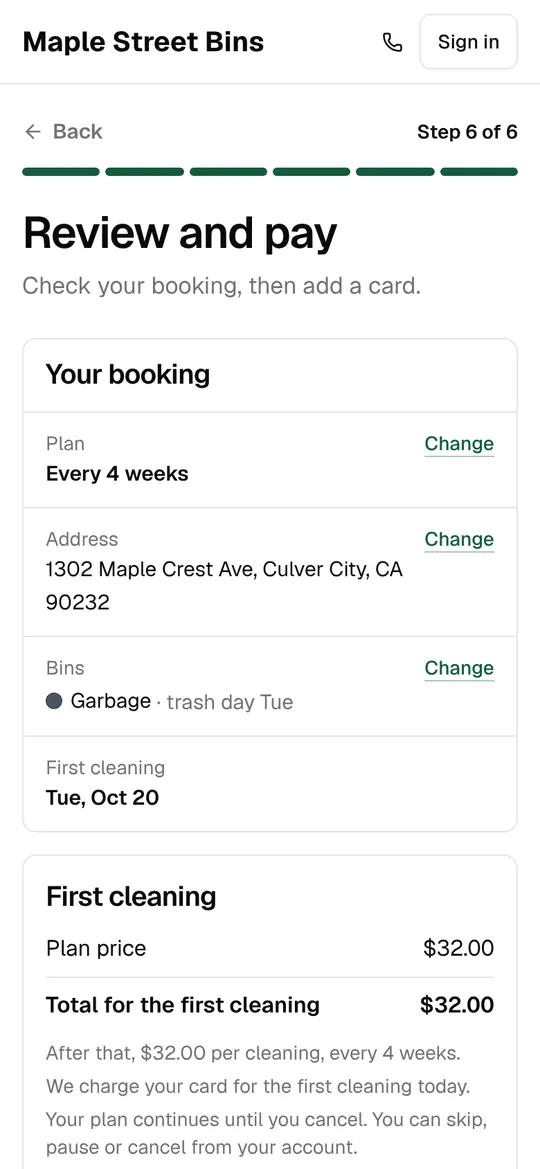
City pages, done right. Fresh Bins LA has 31 city pages. Google calls pages that only swap the town name “doorway” pages, and mass-produced pages “scaled content abuse” (Google). Give each city page something real: that town’s trash days and hauler, the neighborhoods you serve, local photos and reviews, and the price.
What a site costs:
| Option | Listed price |
|---|---|
| Wix | $17.77 to $39.77 a month, billed yearly; online payments from the $29.77 plan |
| Squarespace | $19 to $99 a month, billed yearly |
| GoHighLevel | $97 to $497 a month, with booking, email and texts |
| Jobber Core | Includes a simple website with online booking |
| BinClean Marketing | $230 a month for a website, Google profile, Clean Bin System setup and upkeep |
| A .com domain | About $11 a year |
Sources: Wix, Squarespace, GoHighLevel, Jobber, BinClean Marketing, checked October 2026. BinClean Marketing is run by the author of this course.
Track from day one. Install Google Analytics and the Google Ads and Meta tags, and carry the ad click into checkout. One in five bin cleaning sites has no tracking at all.
Google Ads: a playbook that paid back
Fresh Bins LA’s Google Ads, from launch to September 30, 2026:
| Ad spend | $864 |
| New paying customers | 21 |
| Cost per new paying customer | $41 |
| Average first payment | $117 |
Each new customer paid back their ad cost almost three times over on the first charge. For comparison, a 2026 benchmark for home-improvement businesses puts the average cost per lead, not per customer, at $90.92 (LocaliQ).
What made it work:
- Customers’ words. Separate ad groups for “trash can cleaning,” “trash bin cleaning,” “near me,” city names and price searches, each with its own ads. “Smelly bin” searches and competitors’ names produced no sales from 20 clicks.
- The price in the ad, with price searches sent to a page that shows prices.
- Broad match plus a long negative list. 128 negative keywords, in groups: people buying cans or supplies, people starting a business (“how to start,” “franchise,” “trailer”), do-it-yourselfers (“vinegar,” “bleach”), job seekers, and the wrong service (“trash pickup,” “junk removal”). Switching to only phrase and exact match cut reach 40% and the sales stopped.
- The right ZIP codes. Three areas produced 27 of the first 29 conversions, so the rest were cut.
- Bidding on the brand name, which is cheap and keeps competitors off it.
- Counting payments, not Google’s conversions. Google counted more conversions than Stripe showed paying customers. Budget decisions ran off Stripe.
Settings to check:
- Location: Google’s default reaches people “in or interested in” your area. “Presence” reaches people who are actually there (Google). You can only serve people who live there.
- Budget: a campaign can spend up to twice its daily budget on a given day, but no more than 30.4 times it in a month (Google). Start small and raise it once you know your cost per paying customer.
- Seasons: smelly-cart searches peak in summer and slow from November to February. Follow demand.
The full walk-through is in BinClean Marketing’s guide to Google Ads for bin cleaning.
Facebook and Instagram ads
Facebook and Instagram are better for building demand around your existing routes than for catching people ready to book. Only 7% of companies run them. Of the 29 bin cleaners running them in October 2026, 28 talked about smell, bugs or germs, and 10 offered 50% off.
Angles worth trying:
- Proof: cleanings done, reviews, years in business.
- A plain story: that the service exists, how it works, when you come.
- A strong guarantee.
- The price up front.
Target your route ZIP codes or tight areas around your stops, not whole metros. Meta’s default around a city adds 25 miles, which you can cut to 10. Use your own before-and-after photos and short videos of your rig at the curb.
Nextdoor ads
Nextdoor sells image, video and lead ads in the newsfeed, targeted by ZIP code or a radius up to 30 miles, with daily or total budgets (Nextdoor). It publishes no minimum budget. Test a small budget on the streets where you already have customers.
What to track
| Measure | How to get it | Fresh Bins LA |
|---|---|---|
| Cost per paying customer | Ad spend divided by new paying customers, from your payments | $864 ÷ 21 = $41 |
| First-payment payback | Average first payment divided by cost per customer | $117 ÷ $41 ≈ 2.9 times |
| Results by ZIP code and search | Your ads reports, matched to sign-ups | 3 areas brought 27 of 29 conversions |
| Plan mix by source | Monthly, quarterly and one-time sign-ups from each channel | |
| Early cancellations by source | Cancellations in the first 90 days | |
| Door hangers and partners | Redemptions of each code |
The question isn’t “how much should I spend,” it’s “how much is a customer worth” (Lesson 7). A customer who stays a year on a monthly plan is worth far more than their first cleaning.
Be careful what your ads claim
You need proof before an ad runs, and health claims like “kills 99.9% of germs” need competent and reliable scientific evidence (FTC). 22 of the 29 Facebook and Instagram ads we captured talked about germs or sanitizing. Only claim what the product you use is registered and proven to do (Lesson 3), and say what you actually do about the environment rather than “eco-friendly” (Lesson 5).
Key takeaways
- The biggest bin cleaners are also the easiest to find on Google: ads, bigger sites, city pages and reviews.
- Set up your Google profile as a service-area business with your real name; put prices in Services, not the description.
- Ask every customer for a review, but never offer anything for one, never gate them, and never ask customers to name a technician.
- Your website needs prices, a Book button that takes a card, real photos and a real page for each city.
- Run Google Ads on “trash can” searches in your best ZIP codes, with a long negative list, and judge them by paying customers.
FAQ
How do I get my bin cleaning business on Google?
Create a free Google Business Profile as a service-area business: use your real business name, hide your address, list up to 20 cities or ZIP codes you serve, add your services with prices, upload real photos, and verify the profile. Then ask every customer for a review and link your website.
What category should a bin cleaning business use on Google?
Google’s list may not have an exact bin cleaning category. Larger bin cleaners use “Pressure washing service.” Search “trash can cleaning” in your city, check the categories the top three map results use, and pick the closest one that finishes “This business is a…”
Can I give customers a discount for leaving a Google review?
No. Google’s policy bans any incentive for a review, including discounts, free cleanings and prize drawings, and since April 2026 also bans asking customers to name a technician. You can and should ask every customer for an honest review.
How much should I spend on Google Ads for bin cleaning?
Start small, in your best ZIP codes, and measure cost per paying customer from your payments, not Google’s conversion count. Fresh Bins LA spent $864 to win 21 paying customers at $41 each, who paid an average of $117 on their first charge. Raise the budget once you know your number.
Do Facebook ads work for bin cleaning?
They work better for building awareness around your routes than for finding people ready to book. Only 7% of bin cleaners run them, mostly with smell and maggot photos and a first-clean discount. Target tight areas around your existing customers and use your own before-and-after photos.